After four years, and many life changes, I'm writing a fresh post!
The start of every year, begins with seed catalogs...! this season, I'm planting seeds of fool-proof plants that can take the extremes of Midwestern weather, and still produce quality cut flowers.
This list is topped with Zinnias, followed by Cosmos, then tall Marigolds, Snapdragons and Sunflowers. there are many more plants to trial, but these are mainstays of the summer cutting garden.
Of course, I MUST plant Sweetpeas, a yearly ritual that brings me back with memories of me and my Dad in his garden. My father learned to plant the fragrant flowers from his Auntie, who also had Peonies, Iris and a large vegetable garden for the house- a necessary element in a turn of the century household. sweet peas have been growing since before Christmas, and later varieties are just coming up now.
the old timers would say to plant seed outdoors by St. Valentine's Day, but I find that I get better cutting stems if they are started much earlier. the real secret to decent bloom before the heat hits, is to not let the young plants get pot bound, and to move them up to larger sized pots as they grow.
I like to use recycled beer cups, the kind you get at a sports event.
You can use new cups of course, but in any case, good drainage is a must! I stack many together, then use a drill bit to make four uniform holes in all the "pots" at once.
bright sunlight or quality artificial light for twelve hours a day gives you stocky, lush growth. keeping seedlings of all types well watered and fed can and should be a daily habit .
time spent now, nurturing the small seedlings will pay off big in the near future, I'm itching to get growing outside!
Tuesday, January 27, 2015


Tuesday, November 1, 2011
Indian Summer's End
The frosts have touched the garden, yet pockets of life survived the cold. The days have been warm and somewhat windy, always calming down by dusk. As I walk with Darla down the long drive, We go in and out of warm temperature layers, almost like how lake water can be, depending on the depth.The spicy scent of oak leaves and tall grass and the pungent stank of a buck in rut, somewhere close.
I have the native orchid Spiranthes species, blooming in the grass, like little fairy wands. These vanilla scented wildflowers are always a treat to look foreword to during October. I found a beautiful cultivated variety at a local nursery, to add to a shade garden by my house. It is at least four times the size of my delicate native variety-I love then both!
 My local native Spiranthes, could be S. cernua?
 I am not a big fan of all the "landscape" roses being sold everywhere here, but I bought on on sale, to fill a
spot in my front garden. It has been one of the most colorful, healthy roses I have ever had! It's called R."carefree celebration", a glowing coral pink that blooms and blooms-non stop! It has even gone through a light frost, and till kept blooming!
 The Great Blue Lobelia-Lobelia sphilitica
 I've always taken long walks, as a child with my dad, and now with my dog, Darla. We explore all the many areas of the farm, so I'm more likely to find special plants and flowers in isolated spots. We had a horribly dry fall, it still is- my pond is three feet down from normal, but the grass is still somewhat green.On a walk with Darla a week or so ago, I found a beautiful Lobelia siphilictica, the Great Blue Lobelia. If it hadn't been so dry, they would be in many spots, but not this year!
A few weeks ago, I went on a hike with my friend Jeff at the creek at the front of the farm. Normally, this would have flowing water, but it's just puddles in places right now, so it was a good time to explore, when we could walk it's shore. We found a pretty blue Campanula americana overhanging the edge, so beautiful.


Campanula americana

I have the native orchid Spiranthes species, blooming in the grass, like little fairy wands. These vanilla scented wildflowers are always a treat to look foreword to during October. I found a beautiful cultivated variety at a local nursery, to add to a shade garden by my house. It is at least four times the size of my delicate native variety-I love then both!


spot in my front garden. It has been one of the most colorful, healthy roses I have ever had! It's called R."carefree celebration", a glowing coral pink that blooms and blooms-non stop! It has even gone through a light frost, and till kept blooming!


A few weeks ago, I went on a hike with my friend Jeff at the creek at the front of the farm. Normally, this would have flowing water, but it's just puddles in places right now, so it was a good time to explore, when we could walk it's shore. We found a pretty blue Campanula americana overhanging the edge, so beautiful.


Campanula americana
Friday, October 28, 2011
Beauty Before the Frost

In the last glorious weeks prior to our first frost, fragile beauty abounds. Every year, I add a few more Colchicums, They are referred to as autumn crocus, but that title has already been taken by the real autumn flowering crocus, a very different thing, and genus. Colchicums bloom at the time when every gardener needs a shot in the arm! Their interesting foliage arrives in the spring when everything else is surging in to bloom.It is gone before you know it, blending away in the cacophony of Hosta, Violet and Monarda leaves surrounding them. The garden fills in and blooms, going through the spring and summer seasons, then it slows way down, the heat and lack of rain taking their toll. Then, in early October , we get a decent rain storm. The rain triggers the Colchicums to surge in to growth, literally over night. The buds appear like a true Crocus, but continue to expand and grow in to a large clump of translucent lavender bloom. They are supposed to spread, but mine have not so far. There are many varieties to try, double, whites, checkered-they are pricey, but get better every year, and live long lives in the perennial garden.

This little Morning Glory, Ipomea sp. has traveled with me through my entire life. When I was little, I would help my father in the vegetable garden, were we also grew Sweetpeas for the house, as well as broken, flamed tulips, sweet Williams and this little beauty self seeded every year.I would gather the light tan seed pods in the fall, crumbling their shells off, exposing the jet black seed.When I moved away from home, the first garden I created, I plantd these simple flowers. You would think that they would be invasive, like the variety I."Grandpa Ott's", but it keeps a low profile, never taking over the scene. This spring, my neighbors Ann and John gave me some seed they had saved from the same type of Morning glory, so I have "fresh blood" for the next seasons progeny, It's like a miniature I."Heavenly Blue", but with tri-lobed leaves,( and not the species I.triloba..) Does anyone know what variety this is? I found this vine growing through an Abolone shell by my door, what a perfect combination!

Anemone japonica "Whirlwind"
Plants that come in to their own in the fall are so underused. These perennial Anemones are fantastic tall flowers to use in groups, or as a soft focal point all by themselves. They are beautiful cut flowers, but the blooms last at least a month on the plant if they are getting ample moisture. There are varieties in white, pink, mauve, raspberry-some single, others fully double. They will bloom until a hard frost, and even then, you might get some continued blooming if an Indian Summer settles in. This is a new one for me, and I've planted it in more sunlight this time, and gave it more organic matter in it's planting hole, I think the change will be good, my others are planted in dry shade, and suffer from low moisture in the soil. The new planting bed will be kept a little wetter than most of the areas in my gardens.

I love this Iris, it blooms beautifully in the spring with the rest of the Iris, but then reblooms again in the fall, especially if it's gotten good care during the growing season. These Iris are called remontant, and there are many other colors and varieties to try! This is an oldie, but a goody,with very fragrant blooms, a whisper of pale blue on a pure white ground. Remember to never plant a tall bearded Iris too deep-their rhizome needs to see some sun, half out of the ground, like a turtle in the water. The night after I took this picture , we had the hard freeze, ending the party, but this was the last blossom on the plant, so it was great timing!

I love Tricyrtis, the Toad Lilies. I would have a serious collecting lust for them, but I loose them after a year or two, due to the population of voles that eat their roots in the winter here. I guess I could grow them in wire baskets, sunk in the ground, but that's not my style. I enjoy them for a few seasons, then get a few new ones to grace the fall shade garden. They look like tropical lilies or orchids, often banded and speckled with purple and brown. Although none of them are what I would call tall, they make great cut flowers, exquisite and long lasting. Some have striped foliage, or even spotted. Great companions of Epimediums, small Hosta, and ferns. Dappled light, even moisture and a light organic mulch will suite them well-and if happy, they will form gently expanding colonies. They are also super in containers with similar shade loving plants or all by themselves in a group.
Tuesday, October 4, 2011
Spider Lilies Steal the Show in Late Summer
 |
| Lycoris radiata radiata-Red Surprise lily |


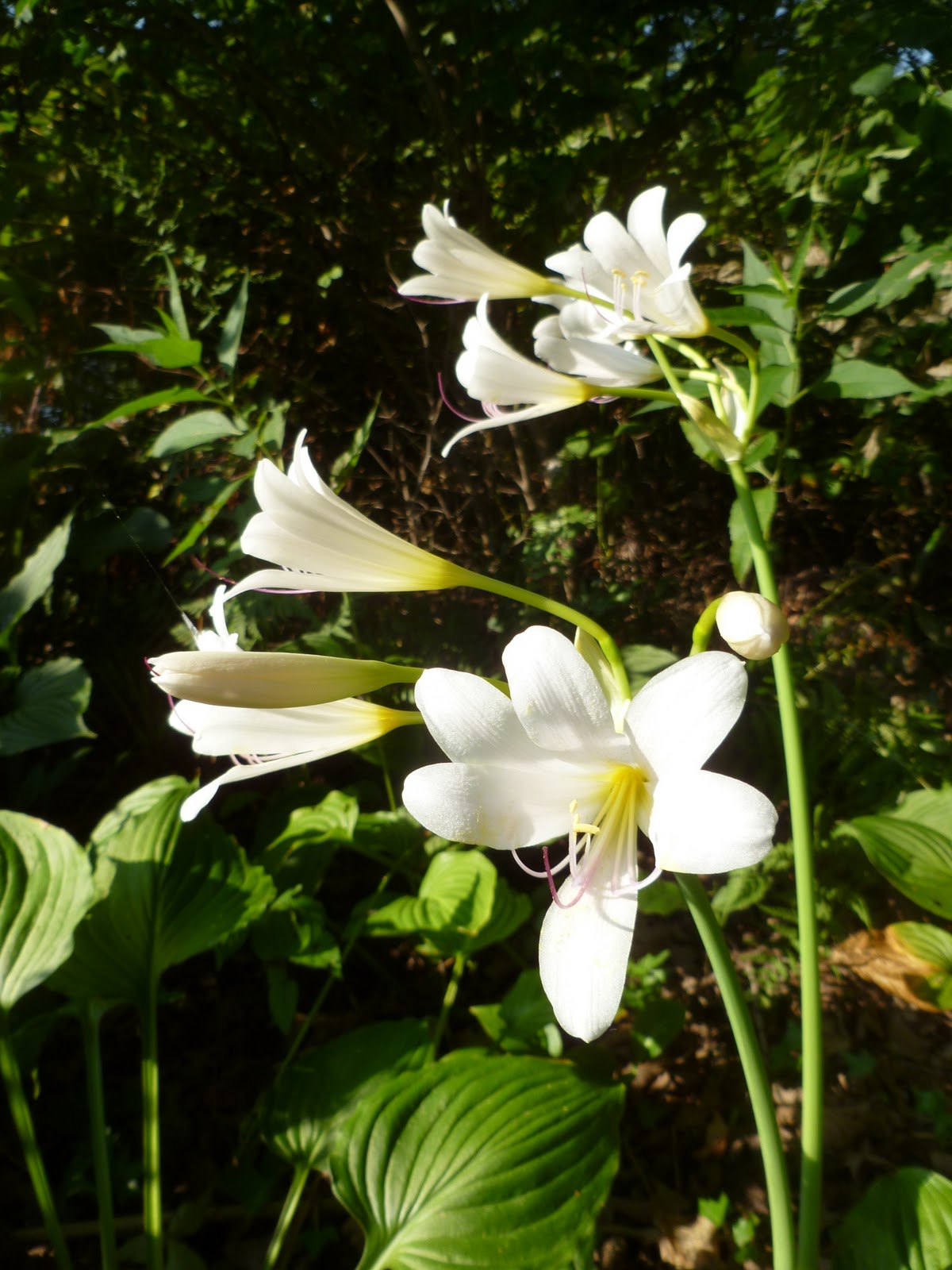
These are the most common one you will see in the southern United States.These are sterile, polyploid plants, producing a larger, more showy display. There is another L.radiata,---pumila. I think this is the original species, that's still fertile and seed bearing, and half the stature of the popular L.radiata radiata.I'm buying some bulbs from a new collection from china, this is great, because I will have a whole new gene pool to work with. It seems like only about half of the discovered "species" are really natural, sterile hybrids that can only be multiplied by a slow division of the bulbs. One species that is a likely natural hybrid is, Lycoris houdyshelii. This spider lily is a real stunner! It has about the same stature as L. radiata, but the bloom cluster is larger and more ruffled. It is norrmaly a creamy white with streaks of pale pink, getting stronger with age. When I took this shot, only a touch of pink was apparent, due to the 100 degree weather we were having. Cooler temperatures would have brought out more blush, but it's still a highlight in my late season garden.

Another amazing species is believed to be one of the parents of the popular Naked Lady pink surprise lily, L.squamigera. The other participant in this clandestine mating is most likely L. longituba. This is the spectacular L.sprengeri. It will not only surprise you with it's appearance seemingly out of nowhere, but with it's shocking true blue petals. The base of each petal in a bubble gum pink, but depending on the individual plant, it can be almost entirely covered with electric blue!


The last one I'll talk about, is actually the first to bloom, late July here in the central Midwest. Lycoris sanguinea var.kuisiana is a demure plant, with smooth petals, in a soft salmon orange color. It has been shy to bloom for me, alternating years at this point. I believe in spreads by runners or roots, because it has shown up at least three feet away from the original bulb. It has never set seed that I know of, but that could be an answer as well! This year, just as the first and only stem was making it's debut, a snail got to the flower stalk and ate right through it! I found it laying on the ground, decapitated. Oh well, one more year I won't get seed! UGG. I brought it in to the house were it bloomed for well over a week. Lycoris make excellent cut flowers!

There are some truly beautiful man made hybrids and more species as well--these are all hardy in my zone 5 garden, there are more tender species and cultivars for a little warmer location, in to zone 7-8. Dappled light and adequate moisture is all they need. The "neck" of the bulbs need to be just below the ground surface, but mulch and ground covers are a good idea. They are perfect with Hosta plants, and you can pair the different statures with a appropriate mate in scale-as Hosta come in all sizes too! Surprise yourself, try some Lycoris this year, they get better every season!
Sources: Telos Rare bulbs, Plant Delights nursery, Bulbmeister.com and other specialty bulb vendors-even ebay!
Wednesday, September 28, 2011
Loving Lycoris


Tuesday, February 15, 2011
A Hyacinth Update in the Month of Love...


I'll bring this first group inside, keeping them well watered and cool-warm temperature can be disatrous at this point, the flower stalk needs time to elongate before flowering. Sometimes, if the temperature is too hot, the flowers will almost bloom down deep, inside the bulb, ruining the display. I always add fresh, live sheet moss to my bulb pots, it looks natural and keeps the soil moist and cool.
Tuesday, February 1, 2011
Festival of Snow


Sunday, November 7, 2010
Hyacinth Crazy


I began forcing Hyacinth and other bulbs as a boy with my dad. We had a small collection of Danish forcing vases brought back from living abroad in the late fifties and early sixties. We would search out the largest bulbs we could find at local garden centers, or order from "wish book" catalogs that I read front to back. My father taught me to always add a little activated charcoal to the shapely vases to keep the water sweet. We would wash the vases, and fill them nearly to the "neck" where the fat bulb would sit. The water level should always be just below the base of the bulb, not sitting in the water, but just above.
You can force any Hyacinth bulb, not just the more expensive, pre-chilled varieties. Once the vase is filled, adding a piece or two of the activated charcoal, you are ready to go! All the bulbs need now is eight to twelve weeks of cool rooting in darkness. The ideal temperature is between forty degrees and fifty degrees. Ideal places are cabinets in heated garages, cool cellars, deep cold frames or even that spare beer refrigerator down in the basement! make sure the vases never freeze, just cool and dark. Now check on the water level every few weeks, and top it up to the base of the bulb, but just below it. If the water gets cloudy, just change it-but this rarely happens.

Collectible antique Hyacinths in pots, ready to root and be cooled...the anticipation is killing me!
Every variety has it's own internal clock that is controlled by the gibberellic acid that needs time to develop in order for the flower stem to grow and lengthen properly. Some Hyacinth may only need eight weeks or so,others will need more time. How will you know when to bring your Hyacinths out of there cold-dark period? The roots will have filled out the bottom of the vase, and the top growth will have lengthened a few inches, then they can start their journey to bloom!

When the bulbs are well rooted, and top growth is evident, bring your Hyacinth vase into a cool, dim light for a day or so, then to brighter light still. Turn the vase regularly to keep the bulb growing evenly. The cooler the spot, the longer the Hyacinth will stay in bloom!
If the vase method sounds too hard (it's so easy), an even easier way is to keep the bulbs in a refrigerator, in a brown paper bag, and chill for at least eight to twelve weeks, then let the bulbs root directly in cool brightness, even a kitchen window sill.
I'm collecting antique varieties, and for those, I have bulbs growing in a sandy potting soil, so I can easily keep the rare varieties in their own pots. Each variety has it's own unique scent, like a rose does. Colors- wow, so many great subtle tints, like water colors or multi- colored gem stones. To grow and "force" Hyacinths in pots, just use a sandy soil mix, place the bulb below the soil surface, water well and let root for the eight to twelve weeks in cool darkness-a cold frame, root cellar (I know, who has them any more..) cool basement or even a trench out in the vegetable garden.Can you use a refrigerator? yes you can! If they are outside in the ground, fill clean sand around the pots, then cover with straw and a few boards to keep them tucked in for the rooting period. Bring in a few pots at a time to draw out the season-well before the real spring has arrived! Easily found antique varieties include pale pink "Lady Derby"-1875, pure white "L'innocence"-1863, Easter yellow "City of Haarlem"-1893 and the beautiful salmon "Gypsy Queen"-1927 Try your local garden center, or order on line from McClure and Zimmerman, Old House Gardens, or Brent and Becky's bulbs. If the provenance isn't important to you, just buy a mixed bag from your local home store and be pleasantly surprised when they bloom, you won't be disappointed! Most will cost a dollar or less, more rare varieties will be much higher in cost.


Tuesday, November 2, 2010
A Night of Family-Halloween for Me
I have always loved Halloween, in old Irish Samhain (Sow- won), celebrating the spirit world, and all those souls that came before me. Far from a night of terror, I think of it as a soul celebration, and invite all those that have passed before me to join and be celebrated.
 I started my day by cleaning the house, getting things "in order" for the week. I went out to the vegetable garden and found the last three pumpkins to carve for the holiday.This year, I decided to carve my jack o' lanterns with the family names of my Irish heritage. I thought it might help welcome my family to my spirit party!
 I began looking for all things Halloween, and found some likely candidates...My glossy black Sumatra hens were dressed for the occasion! They had a large helping of pumpkin guts as their "treat"for the special day. At work, I've carved A LOT of jack o' lanterns...at least twenty five I think, most were for a fantastic party one of my clients has for her lady friends, they go all out!

 After I fed the birds their treat, I went to the greenhouse and found some more likely holiday faces, the always cheerful pansies gave good face..like goblins with a sunny disposition ;)
 I spent the rest of the daytime gathering wood and brush for a huge bonfire later in the evening. The days get shorter and shorter, and I was really rushing that last hour of light, assembling my pyre for the night. I came inside and made dinner, then set about carving my pumpkins for the night. I loved that they were my own produce-I buy a ton from a specialty grower near me, and they do a great job(Schaakes' Pumpkin Patch) but these were the last from my own hands, and that gave my great joy! When I was done with the carving, I lit them, along with lots more candles and had dinner. Was I alone? funny, I felt like I was in great company! I took my orange friends out to the site of my bonfire, and gave them a proper seat for the festivities-an old Victorian wirework plant stand was perfect!
Then it was time to set it all a blaze....the perfect temperature for a good spirited fire. It only took a few moments for it to really take off, and boy, did it burn!!!


I enjoyed the flames until after midnight, the sparks rising higher and higher, disappearing into the black and starry night. When the fire was behaving in a more manageable way, I took the pumpkin with my mother's family name up into the woods where my mom's memorial Oak tree stands, surrounded by her ashes- and placed the ceremonial offering at the base of her tree, glowing a beautiful, rich orange in the dark.

Maybe, just maybe,I'll have flesh and blood guests for this event someday, but I was not alone, that's for certain! I hope everyone takes a bit of time to celebrate those that came before us, and say thank you for the life we all enjoy! Happy Halloween to you all ;)
.


Then it was time to set it all a blaze....the perfect temperature for a good spirited fire. It only took a few moments for it to really take off, and boy, did it burn!!!


I enjoyed the flames until after midnight, the sparks rising higher and higher, disappearing into the black and starry night. When the fire was behaving in a more manageable way, I took the pumpkin with my mother's family name up into the woods where my mom's memorial Oak tree stands, surrounded by her ashes- and placed the ceremonial offering at the base of her tree, glowing a beautiful, rich orange in the dark.

Maybe, just maybe,I'll have flesh and blood guests for this event someday, but I was not alone, that's for certain! I hope everyone takes a bit of time to celebrate those that came before us, and say thank you for the life we all enjoy! Happy Halloween to you all ;)
.
Saturday, October 23, 2010
Searching Out the Elusive Roman Hyacinth...
Once upon a time, long ago, a delightful and fragrant bulb was grown during the winter and spring months to celebrate the miracle of spring, albeit a bit early. Nobody knows who first began to "force" Hyacinths, both in soil as well as a novel and beautiful method of growing in specially designed Hyacinth vases, but it became a very popular hobby for the horticulturally inclined in most of the western world.
 The many amazing varieties that have been bred in the last three hundred years can all be tricked into early bloom, but the queen of the hyacinths is the wild species, known as the French-Roman Hyacinth. The primary hybridisers have always been the Dutch, and at one point, Hyacinths were at a similar frenzy of popularity that the Tulip is famous for. Double blooms,single blooms, more and more colors were selected and developed into the fat fragrant spikes that can scent an entire room with their powerful perfume. The antithesis of all this hybrid frenzy, was the wild Roman Hyacinth. It naturally came in four colors; the first and most common color was a deep blue, then a beautiful pale porcelain blue color, followed by a pure white form and last but not least, the cinnamon scented pink Roman Hyacinth. What makes these Hyacinths so special? Well the primary difference is that the flowers themselves are much more delicate, spaced more widely than the common hybrid sorts. Their scent is more sweet and ethereal, and the best part, is the fact that these bloom with multiple sprays of fairy- wand flowers.
These French -Roman beauties were raised by the millions for the world market, primarily in southern France, and grown in wealthy as well as working class homes.They could be grown in a pot of damp,sandy soil, or in the favored craze of water forcing--early hydroponics. Most reference books claim that these more delicate bulbs could not be grown into a North American zone five-but I've only known them to be completely hardy here. Most Dutch Hyacinths don't perennialize easily, but Roman Hyacinths can make a fine colony in just a few years. You can have them bloom early, then let their foliage continue to grow and mature, replanting them in a fertile place during the next fall season. These Asia minor beauties need to be grown where they will receive good sunlight and moisture early on, then have a dry summer rest. I think Around deciduous shrubs is a good choice, assuring a more arid atmosphere compared to a typical well watered flower bed.
So, do you want to go out and buy yourself a big bag full of these great historic bulbs?? Well, that's a little bit of a problem. These were traditional decorations from Christmas through Easter time, gracing windowsills around the world, often grown in small crates as well, wrapped in colorful crepe paper and ribbons, as well as just to cut for vase arrangements. After a hundred years of this hobby, it must have seemed old fashioned and thus less and less desirable for the modern generations that had just discovered the new craze for African violets and other "tropical" beauties as well as the much larger, colorful Dutch hybrid Hyacinths. Even twenty years ago, you could easily order Roman Hyacinths along with all the other popular spring flowering bulbs, today there are no large scale bulb firms that sell the real thing. They may have a hybrid version called a "festival" multi floral Hyacinth, and they are very nice, but impostors, none the less. These are hybrids with the colorful and popular large flowered Dutch Hyacinths with their wild cousins, the true Roman Hyacinth, Hyacinthus orientalis albulus. I think it's important to preserve the species bulbs, and perpetuate them in our modern gardens, as well as our modern lives.
When I became more and more fascinated with these bulbs, I found a few sources for these antique bulbs-and now there is even less availability to buy these treasures. I obtained my first bulbs the best way, I traded another gardener for them. I had spotted a front yard in an old neighborhood, with a fine stand of the pale blue variety. I introduced myself to the owner, a lovely octogenarian, who had moved these bulbs to her present garden thirty years before, a gift from a fellow gardener. She called them blue bells, and they do look a great deal like English blue bells-but are much easier to grow in the United states , and they have the fabulous Hyacinth scent as well. I traded a big clump of hardy Maidenhair fern (Adiantum pedatum) and some White Czar Violets for a nice clump of the antique bulbs. We both felt like we had scored! It's sometimes easier to move bulbs "in the green" as the Britt's say, and you can find the bulbs before they disappear for another summer season
The next year, my friend Tim went to a yard sale for a house that was going to be demolished. The owners had gardened all their lives there, and had dug up many plants to sell before the property was cleared.He bought a group of bulbs, curiously, also referred to as "blue bells". He planted them, and the next spring I was taking a look-see in his garden, when I spied his new charges. These were a dark blue form, and very vigorous. I asked him where he had gotten the Roman Hyacinths, and he told me about the garden sale the year before. We drove back to the house where the sale had been, and found a cleared lot, surrounded by a chain link fence. Now, I'm not one to be deterred by a construction fence, and I found an opening to crawl through. Rough grass was all I saw initially, but then I spotted one and then another deep blue flower stalk, dotted in the wild grass. I had brought a shovel, and began to dig the first bulb. these bulbs were much deeper than I had thought, at least twelve inches deep in the dark soil. I'm not sure if that's how they always grew there, or that the soil depth changed when the house was razed.
This season, I found the cinnamon scented pink form at Old House Gardens. This is a wonderful resource for antique bulbs and flowers, give them a try! the bulbs are expensive, but they multiply and form nice clumps in just a few years. Now, the search is on for the elusive pure white variety. This should not be hard to find, as it was so popular a hundred years ago, but I've hit many dead ends so far. Someone, most likely a southerner, has them growing happily in their gardens. Although the blue forms seem perfectly hardy for me, maybe the white form is truly more tender? I've never seen it in the Midwest. I always keep my eyes open in turn of the century neighborhoods of our area, for a vintage swath of the snowy blooms. If anyone out there in the blog sphere knows of a source, or would like to trade something for some of the alba variety, please let me know!
The next post will continue my obsession with all things Hyacinth (this season...) heirloom varieties and how to grow them, Hyacinth vases,(so collectible) and using hyacinths for beautiful, fragrant bouquets as well as high- end wedding work. Happy Hyacinth hunting!

These French -Roman beauties were raised by the millions for the world market, primarily in southern France, and grown in wealthy as well as working class homes.They could be grown in a pot of damp,sandy soil, or in the favored craze of water forcing--early hydroponics. Most reference books claim that these more delicate bulbs could not be grown into a North American zone five-but I've only known them to be completely hardy here. Most Dutch Hyacinths don't perennialize easily, but Roman Hyacinths can make a fine colony in just a few years. You can have them bloom early, then let their foliage continue to grow and mature, replanting them in a fertile place during the next fall season. These Asia minor beauties need to be grown where they will receive good sunlight and moisture early on, then have a dry summer rest. I think Around deciduous shrubs is a good choice, assuring a more arid atmosphere compared to a typical well watered flower bed.
So, do you want to go out and buy yourself a big bag full of these great historic bulbs?? Well, that's a little bit of a problem. These were traditional decorations from Christmas through Easter time, gracing windowsills around the world, often grown in small crates as well, wrapped in colorful crepe paper and ribbons, as well as just to cut for vase arrangements. After a hundred years of this hobby, it must have seemed old fashioned and thus less and less desirable for the modern generations that had just discovered the new craze for African violets and other "tropical" beauties as well as the much larger, colorful Dutch hybrid Hyacinths. Even twenty years ago, you could easily order Roman Hyacinths along with all the other popular spring flowering bulbs, today there are no large scale bulb firms that sell the real thing. They may have a hybrid version called a "festival" multi floral Hyacinth, and they are very nice, but impostors, none the less. These are hybrids with the colorful and popular large flowered Dutch Hyacinths with their wild cousins, the true Roman Hyacinth, Hyacinthus orientalis albulus. I think it's important to preserve the species bulbs, and perpetuate them in our modern gardens, as well as our modern lives.
When I became more and more fascinated with these bulbs, I found a few sources for these antique bulbs-and now there is even less availability to buy these treasures. I obtained my first bulbs the best way, I traded another gardener for them. I had spotted a front yard in an old neighborhood, with a fine stand of the pale blue variety. I introduced myself to the owner, a lovely octogenarian, who had moved these bulbs to her present garden thirty years before, a gift from a fellow gardener. She called them blue bells, and they do look a great deal like English blue bells-but are much easier to grow in the United states , and they have the fabulous Hyacinth scent as well. I traded a big clump of hardy Maidenhair fern (Adiantum pedatum) and some White Czar Violets for a nice clump of the antique bulbs. We both felt like we had scored! It's sometimes easier to move bulbs "in the green" as the Britt's say, and you can find the bulbs before they disappear for another summer season
The next year, my friend Tim went to a yard sale for a house that was going to be demolished. The owners had gardened all their lives there, and had dug up many plants to sell before the property was cleared.He bought a group of bulbs, curiously, also referred to as "blue bells". He planted them, and the next spring I was taking a look-see in his garden, when I spied his new charges. These were a dark blue form, and very vigorous. I asked him where he had gotten the Roman Hyacinths, and he told me about the garden sale the year before. We drove back to the house where the sale had been, and found a cleared lot, surrounded by a chain link fence. Now, I'm not one to be deterred by a construction fence, and I found an opening to crawl through. Rough grass was all I saw initially, but then I spotted one and then another deep blue flower stalk, dotted in the wild grass. I had brought a shovel, and began to dig the first bulb. these bulbs were much deeper than I had thought, at least twelve inches deep in the dark soil. I'm not sure if that's how they always grew there, or that the soil depth changed when the house was razed.
This season, I found the cinnamon scented pink form at Old House Gardens. This is a wonderful resource for antique bulbs and flowers, give them a try! the bulbs are expensive, but they multiply and form nice clumps in just a few years. Now, the search is on for the elusive pure white variety. This should not be hard to find, as it was so popular a hundred years ago, but I've hit many dead ends so far. Someone, most likely a southerner, has them growing happily in their gardens. Although the blue forms seem perfectly hardy for me, maybe the white form is truly more tender? I've never seen it in the Midwest. I always keep my eyes open in turn of the century neighborhoods of our area, for a vintage swath of the snowy blooms. If anyone out there in the blog sphere knows of a source, or would like to trade something for some of the alba variety, please let me know!
The next post will continue my obsession with all things Hyacinth (this season...) heirloom varieties and how to grow them, Hyacinth vases,(so collectible) and using hyacinths for beautiful, fragrant bouquets as well as high- end wedding work. Happy Hyacinth hunting!
Sunday, October 17, 2010
Last Rose, First Cyclamen...Autumn Begins


When I was little, some of my favorite memories were with my Dad, out in the garden, doing all the things that I still do in the fall. Jack was in charge of the vegetable garden, an anomaly in the suburban neighborhood of my youth. We had a very productive raised bed that fed us for nine months a year, and fed our souls for all twelve. We would bring wheel barrels of compost and aged manure, spreading the"black gold" as he called it. This was never considered work, quite the contrary.
For my mother Marie and I, this was also fall bulb planting time. We would go over all the colorful catalogs, she letting me circle the things that I just couldn't live without. I went for oriental hybrid lillies-("Imperial Silver" was my favorite), while Marie preferred to add to our Narcissus collection that counted in the thousands for a decadent spring display. She liked the fact that they just kept getting better and better, turning our back garden where the Apple trees were, a sea of gold and white. I plant Daffodils and other narcissus with the same excitement...selecting wooded pathways for a secret garden awaiting discovery by a hapless me, forgetting that I had planted in a particular area of Hiddenfield farm. I love that, to be surprised by something I planted to surprise a stranger or friend taking a spring-time walk.
As we would work outdoors, my Dad Jack would take deep breaths and sing an old Irish song, "The Last Rose of Summer"- now he had a decent voice, but rarely sang, so I can still hear him in a clear tenor voice, bringing attention the the start of fall, and of course, those precious last blooms.
Now as many of you know, even in the autumn, life goes on as well as starts anew. I had always read about fall blooming Cyclamen, but had never planted any until I moved to my farm. Two types do especially well here, favoring the ground beneath deciduous Oak trees, nestling themselves and their big corms with the surface roots of the ancient trees.Cyclamen hederifolium and C. coum are special woodland plants that help a weary gardener rejoice in this crisp season. Silvered leaves contrast to the dull browns of the fallen leaves, and pale pink and white blossoms hover over the ground like butterflies that just escaped their cocoon.
I'm rather fond of other fall blooming genera, The Autumn Crocus, not a true Crocus but Colchicums instead, dazzle me with their purple and violet bloom. There are fantastic cultivars out there, but my frugality has me search out the unsold bulbs at a favorite garden center, when they go on sale! "Lilac Wonder" is an old stand by, but so much fun to watch it bloom with no soil or water, brightening a fall window sill. After this quiet miracle is over, a spot is selected beneath a deserving tree, where it will settle in and bloom for generations.Look for a variety called "Waterlily" a more apt name could not be found!
Bittersweet berries make their show, as do the many kinds of Aster and the Sages make a final splash of color in blue, violet and reds. Grasses show that texture is the new reining king of the garden, just awaiting the first frost to sparkle and sway with the colder air pooling around. Sunflowers, just finishing their show, offer abundant food for all the birds.

Subscribe to:
Posts (Atom)


